
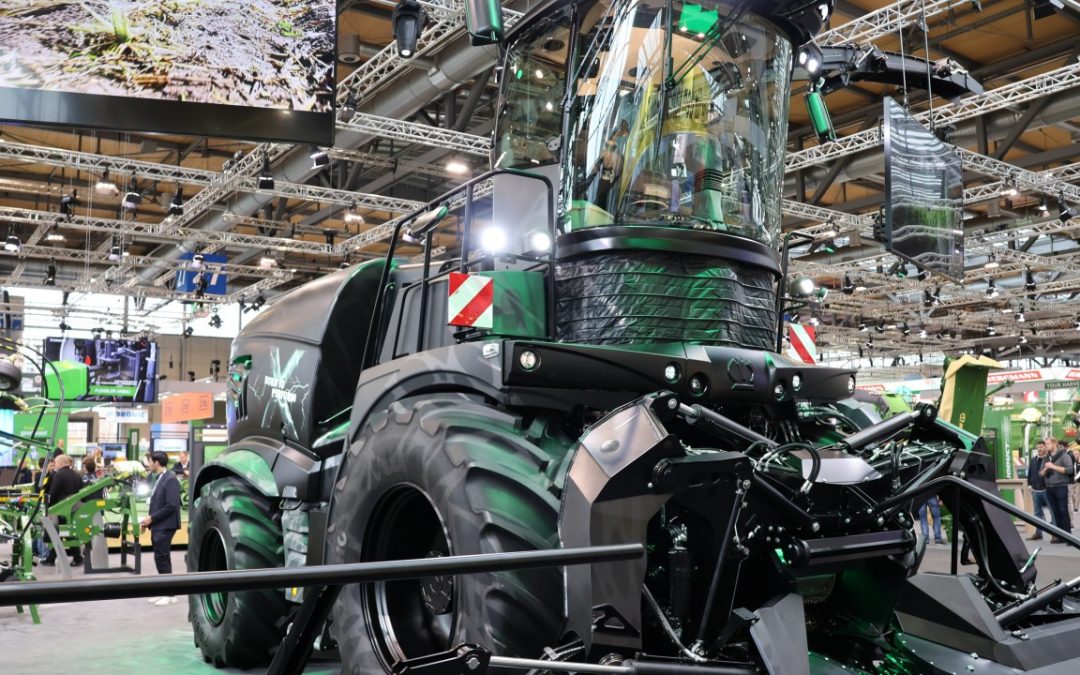
AGRITECHNICA is not just a leading international trade fair for agricultural machinery – it is a real-world market mirror in XXL. For Costineers, it was therefore the ideal location to conduct a comprehensive trade fair audit. Hardly any other context offers such a dense, direct and undistorted representation of what the market is currently achieving. Machines and vehicles are displayed side by side and are openly accessible. You can see how competitors think, design, simplify or even use over-engineered solutions. This transparency opens up enormous opportunities – especially when it comes to benchmarking, product optimisation and cost savings, but also quite simply which additional functions competitors are offering customers… even if it is just a fancy cup holder at mouth level.
The trade fair as an ‘open-air laboratory’: Competition in a confined space
Normally, a product must first be purchased or procured before it can be analysed in detail (classic tear-down workshop as part of a cost value engineering project). At a trade fair like AGRITECHNICA, this does not apply. Entire vehicle ranges – from the base model to the high-end machine – are positioned in the immediate vicinity.
For us as an ‘audit team’, this means:
- Direct 1:1 comparison of all relevant competitor products
- Visibility of design solutions without disassembly
- Identification of functional strengths and weaknesses of individual OEMs
- Identification of trends, system architectures and platform strategies
- Observation of variant concepts and functional scopes
This simultaneous comparison is extremely valuable because it creates an analytical sharpness that is often lacking in everyday project work. You can see at a glance how differently identical technical requirements are implemented – and what impact this likely has on costs, manufacturing effort and serviceability.
Identifying potential before the vehicle has even been in a tear-down workshop
A frequently underestimated point: Many cost reduction approaches do not first arise when a vehicle is dismantled – but much earlier.
At the trade fair, you can already identify:
- Unnecessarily complex solutions from other manufacturers
- Or conversely: smartly simplified system approaches that could make your own product leaner
- Alternative fastening concepts
- Routing that drastically reduces service costs
- Material substitutions and new material trends
- Components that could potentially be purchased instead of being produced in-house at great expense
This initial ‘spark of an idea’ is particularly valuable. Even before an OEM spends budget on a full tear-down, Costineers can provide concrete indications of where potential lies – and which manufacturers should be given special attention.
The advantage: Overview before detail – and thus a very efficient start to a subsequent cost value engineering project.
Systematic benchmarking methodology: Structure instead of a stroll
A trade fair audit is not a random wander, but follows a clear process. At Costineers, this typically includes:
- Definition of target systems Which assemblies, functions or variants should be specifically observed?
- Structured recording format Photos, technical observations, sketches, measuring points, comparison criteria.
- Comparison across multiple manufacturers Evaluation according to criteria such as manufacturing simplification, component standardisation, degree of innovation or variant logic.
- Hypothesis formation on cost influences Where could this solution be cheaper? Where more expensive? Where might there be a strategic decision behind it?
- Documentation in evaluation folders Clearly structured – for later deep-dive analyses or workshops.
This creates an objective, reliable picture of the market – usable for engineering, purchasing, product management and management decisions.
On-site discussions: The underestimated treasure trove of information
Another advantage of the trade fair audit lies beyond the vehicles: discussions with sales, product managers and stand personnel.
Many underestimate how openly contacts speak at trade fairs – especially when the conversation takes place on an equal footing.
Typical information you receive:
- Background to new model generations
- Vertical integration and make-or-buy strategies
- Challenges in production and quality
- Reasons for specific technical designs
- Information on suppliers, system partners or development cooperations
- Information on planned specification streamlining or series simplifications
- Market trends, price ranges and positioning strategies
These insights link visible technology with invisible decision-making logic. This creates a much more complete picture than a purely static product scan could ever provide.
Why trade fair audits are a strategic instrument – not just a technical gimmick
For Costineers, trade fair audits are not just a technical tool, but a strategic building block to:
- identify project priorities at an early stage
- recognise cost-down potential
- systematically understand alternative approaches of other OEMs
- spot innovation focal points
- align engineering and purchasing more purposefully
- plan tear-down strategies more specifically
In addition, they provide a compact, extremely market-oriented picture – exactly what many decision-makers need before far-reaching cost engineering or product decisions are made.
Conclusion: Trade fair audits create clarity, inspiration and cost advantages
The trade fair audit at AGRITECHNICA clearly demonstrated the value of such an approach: It offers rapid transparency, well-founded comparisons and provides initial concrete optimisation impulses, long before a tool is even touched or a vehicle is dismantled.
For companies that want to reduce costs, improve products or better understand the market, a trade fair audit is therefore a highly efficient and often underestimated instrument.
Costineers consistently uses this opportunity – and shows that the first step towards successful cost savings already begins at the exhibition stand.

