
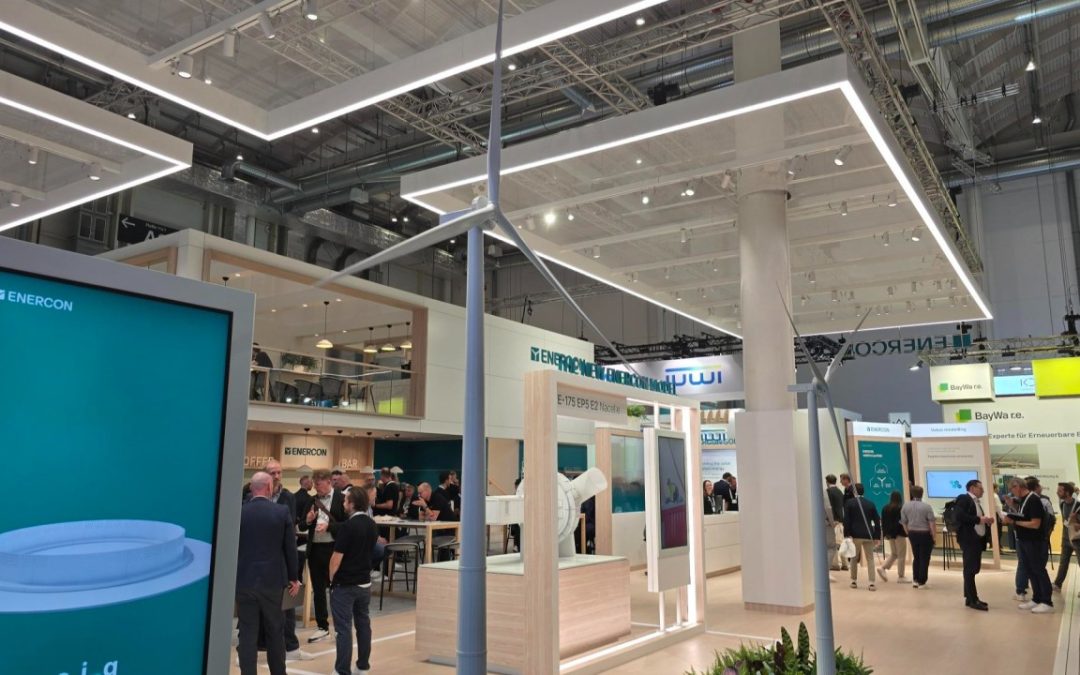
What Costineers observed at the world’s leading wind industry trade fair
WindEnergy Hamburg has been the most important meeting point for the onshore and offshore wind industry for years. We were there on the opening day, and our visit clearly showed: the industry is growing again, but the question of costs has now taken centre stage.
More than 1,600 exhibitors from around 40 countries, over 300 speakers across six stages, 83,000 square metres of exhibition space, and up to 43,000 expected visitors from 100 nations: these figures alone highlight the fair’s significance. For us as Cost Engineers, however, one thing was particularly interesting: what was said between the lines of the opening speeches and within the halls.
The New Momentum: The Industry Is Delivering Again
After years of sluggish expansion, wind energy in Germany is regaining momentum. In 2025, 4.6 GW were newly installed onshore, approximately 75 per cent more than the previous year. Offshore, installed capacity has risen above 10 GW for the first time. Wind energy now covers more than a quarter of Germany’s gross electricity consumption.
The mood across Europe is also positive. WindEurope CEO Tinne Van der Straeten stated at the opening that Europe is on track to install 24 GW this year. She clearly placed wind energy in a geopolitical context: its expansion saves Europe 65 LNG tankers each year. “That is sovereignty.”
Ben Backwell from the Global Wind Energy Council echoed a similar sentiment. Countries, companies, and households increasingly view wind as the most reliable and cost-effective solution.
So, the demand is there. This is precisely where the question that concerns us at Costineers begins: At what cost will this growth be delivered?
Politics with a Price Tag: The Cost Side Takes Centre Stage
Stefan Rouenhoff, Parliamentary State Secretary at the Federal Ministry for Economic Affairs, opened the fair. He made it clear that the Federal Government is committed to renewable energies. However, he added that “the cost side must also be kept in mind.”
This statement is more than a side note. It marks a shift: it is no longer about whether wind power will be expanded, but what the expansion costs and who bears these costs. Discussions surrounding the EEG amendment, new rules for offshore tenders, and three key legislative proposals in the autumn show that the framework conditions are currently being redrawn. Rouenhoff emphasised that they absolutely want to “avoid any disruption to the expansion.”
Associations, including BWE President Bärbel Heidebroek and VDMA Power Systems, primarily called for one thing: planning certainty. This is understandable. From a cost perspective, however, it also means that those who wish to rely on dependable framework conditions must, in turn, be able to demonstrate that they produce efficiently.
New Competitors, New Price Benchmarks
It was impossible to overlook the confident presence of Chinese manufacturers in Hamburg. CRRC, for example, showcased a portfolio of more than 80 turbine models, from 1.5 MW onshore to 20 MW offshore. The company received TÜV SÜD type certification for a 7.15 MW turbine and highlighted over 20 of its own manufacturing sites worldwide.
Such appearances shift the benchmarks. European OEMs and their suppliers will increasingly have to compete on prices that originate from entirely different cost structures. The crucial question will no longer be “What does our product cost?” but “What should it cost, and why does it cost more from us?”
This is precisely where Should-Costing comes in. Anyone who can break down the costs of a nacelle, a gearbox, or a tower segment to material, process steps, and manufacturing time knows where the gap to the competition arises. And they know which part of that is structure-related and which is process-related.
From Order Book to Margin: The Real Test
Full order books do not automatically equate to healthy margins. Several major manufacturers have learned this painfully in recent years. The ramp-up now underway brings with it the classic challenges of industrialisation:
- Capacities must be rapidly scaled up, often with new suppliers and in new regions.
- Turbines are becoming ever larger, and each platform generation introduces new components, tools, and processes.
- Product variety is growing with site, grid, and certification requirements.
- Supply chains for steel, copper, rare earths, cables, and large components remain vulnerable to price and availability fluctuations.
The question shifts from “Can we deliver?” to “Can we deliver profitably?”. For many companies in the value chain, from OEMs to Tier 2 suppliers, this will be the real test in the coming years.
Storage and System: New Interfaces, New Cost Drivers
For the first time this year, there was a dedicated Energy Storage exhibition spanning 3,600 square metres. This is a clear signal: wind energy is increasingly being conceived as part of an overall system of generation, storage, and grid.
For the industry, this also means new interfaces are emerging, and with them, new cost questions. Those offering hybrid parks, battery storage, or grid-serving functions must understand system costs, not just component costs. Simultaneously, demands on power electronics, control, and integration are increasing. This creates markets, but also cost traps if complexity is not managed from the outset.
Discussions at the Fair: Between Optimism and the Calculator
In our conversations in the halls, similar themes repeatedly arose: How do we respond to price pressure from Asia without sacrificing quality? How do we keep costs under control with increasingly larger turbines and more variants? And how do we secure supply chains without burdening the cost base? For many, Cost Value Engineering has not yet been adopted – yet this very method helps unlock potential.
It was striking: optimism has returned. At the same time, everyone is aware that the next growth phase will unfold differently from the last. It will be decided more by efficiency than by volume.
Conclusion: The Next Phase Belongs to Cost Competence
WindEnergy Hamburg 2026 demonstrated that the wind industry once again has tailwinds, politically, economically, and geopolitically. However, this also increases expectations: for affordable electricity, efficient tenders, and competitive products “Made in Europe”.
The companies that will succeed are those that know their cost structure in detail, actively manage complexity, and implement savings sustainably, rather than just presenting them on slides.
For Costineers , WindEnergy Hamburg was therefore far more than an industry trade fair. It highlighted the challenges the wind industry faces in the coming years and the questions manufacturers and suppliers must now answer to also benefit economically from growth.

