
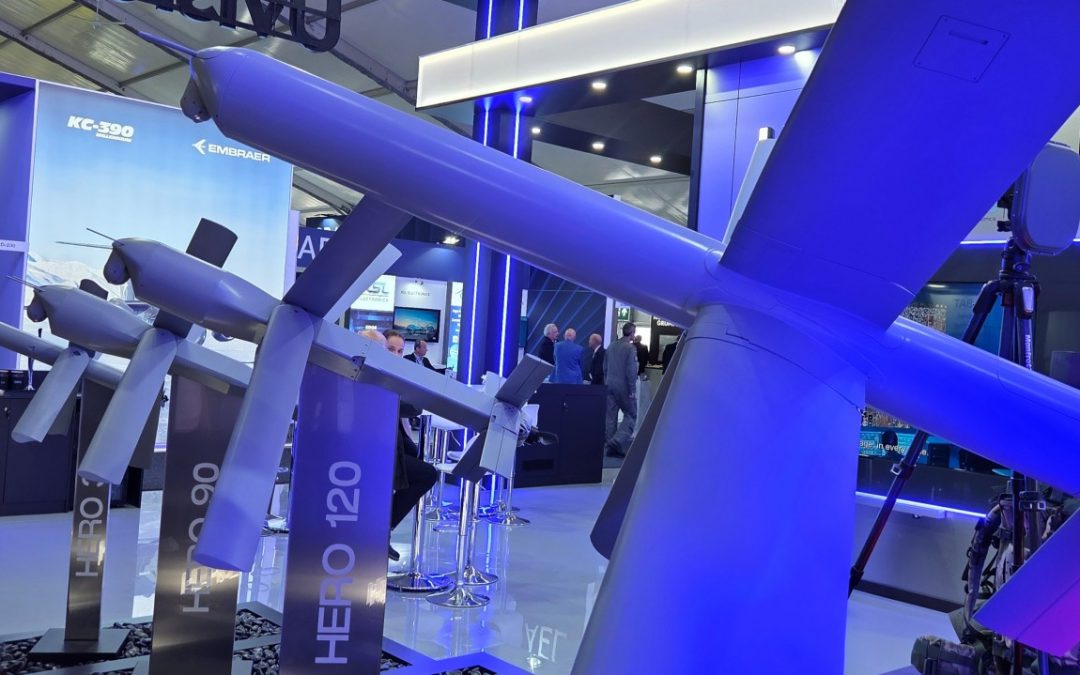
ILA Berlin has always been a showcase for aerospace technology. However, this year’s visit to the trade fair clearly demonstrated that the industry is undergoing a fundamental transformation.
While civilian applications remained present, one topic in particular dominated the halls and outdoor areas: defence technology. New threat landscapes, rising defence budgets, and geopolitical uncertainties have led to military systems currently driving a significant portion of the innovation momentum.
For Costineers, ILA offered far more than a traditional product show. It was a glimpse into the future of an industry that increasingly has to grapple with the same questions many other sectors have faced before:
How can increasing production volumes be managed? How can innovative technologies be produced economically? And how can costs be controlled without compromising system performance?
The New Dynamic: Defence as an Innovation Driver
Anyone who visited ILA a few years ago would hardly have expected the current developments. While military applications were always part of the exhibition, they rarely took such a central stage.
From unmanned systems to sensor technology, communication technologies, and autonomous platforms, right through to new air defence solutions – the pace of innovation is enormous.
Particularly striking was the high number of young companies and start-ups presenting new technologies. Many of these firms bring fresh ideas, agile development processes, and a strong software focus to a traditionally more conservative industry. The innovative power is impressive. Yet, at the same time, a challenge emerges that often only becomes visible in the next development phase.
From Prototype to Series Production: The Real Acid Test
Many of the systems showcased are still in early growth phases. Technical feasibility has often already been proven. However, the crucial question is:
Can the solution also be produced economically in larger quantities?
This is precisely where the classic challenges of Cost Engineering begin:
- Scalable product architectures
- Manageable manufacturing processes
- Standardisation of components
- Supply chain stability
- Make-or-buy decisions
- Variant management
- Cost optimisation without performance loss
What works in prototype construction can quickly lead to significant cost problems in series production. Many start-ups therefore face the same development that almost every successful technology industry has gone through: an innovation lead alone is not enough. In the long term, industrial feasibility and economic scalability determine success.
Start-ups as Future Cost Engineering Candidates
The young defence technology scene, in particular, is likely to be increasingly confronted in the coming years with issues that are already part of the daily routine for established OEMs.
Typical questions will include:
- Which components cause disproportionate costs?
- Where do unnecessary complexities arise?
- Which functions genuinely create customer value?
- Which assemblies can be standardised?
- Which manufacturing steps can be automated?
- Where can existing market standards be utilised?
Many of the innovations showcased today will in future require precisely the cost-down programmes that have been established in other industries for decades.
Trade Fair Audits as an Early Warning System for Market Changes
For Costineers, the particular value of visiting a trade fair lies not solely in the products exhibited. Far more important is the opportunity to identify technological developments, market trends, and future challenges at an early stage.
At ILA, it became clearly visible that:
- Defence technologies are gaining massive importance.
- New market players are entering the competition.
- Software and autonomous systems are becoming increasingly crucial.
- Scaling and industrialisation are coming into sharper focus.
- Cost optimisation will also become a strategic success factor for young technology companies in the future.
It is precisely this combination of innovation and future cost pressure that makes the industry particularly exciting from a Cost Engineering perspective.
Discussions at the Exhibition Stand: Between Euphoria and Reality
Discussions with exhibitors also confirmed many of these observations. The sense of optimism is palpable. New programmes are emerging, investments are flowing, and technological developments are accelerating.
At the same time, there is growing recognition that the real challenge often lies not in development, but in successful industrialisation. Because with increasing production volumes, the demands on procurement, supplier management, manufacturing, and cost control also grow.
The question shifts from “Can we develop this?” to “Can we produce this economically?”.
Conclusion: The Next Phase Belongs to Industrialisation
ILA impressively demonstrated how much the aerospace industry is currently changing. Particularly in the defence sector, numerous innovative solutions and new market players are emerging. However, the innovation phase is inevitably followed by the industrialisation phase.
It is precisely there that topics such as Cost Engineering, Value Engineering, standardisation, and scalability become decisive competitive factors.
For Costineers, ILA was therefore far more than a technology exhibition. It was a look at the challenges of tomorrow – and at the questions many companies will have to answer in the coming years if innovative ideas are to become economically successful products.

